
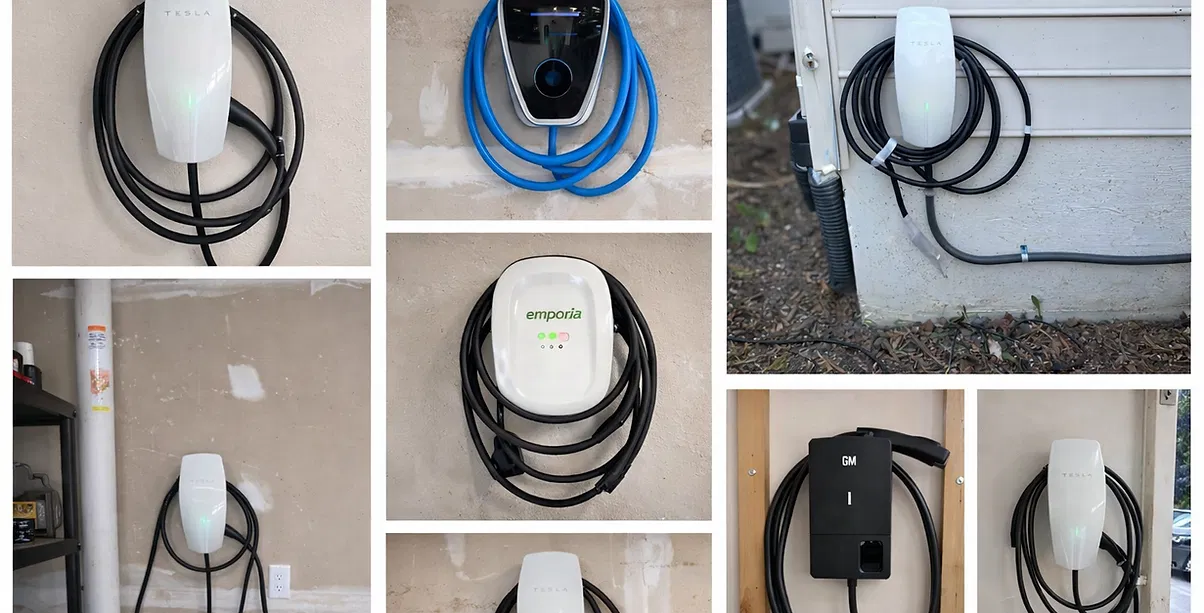
Installing a home EV charger should be more than simply attaching a charging station to the garage wall. A safe and reliable installation must account for your vehicle, daily driving habits, electrical-service capacity, panel condition, charger location, cable route, local permit requirements, and future plans.
That is especially important in Northern Virginia, where homes vary dramatically.
A newer home in Ashburn, Aldie, Gainesville, or Haymarket may have a modern 200-amp electrical panel located inside the garage. An older home in Fairfax, Vienna, Leesburg, Manassas, Sterling, or Warrenton may have limited panel space, a long wiring route, or an electrical system that was never designed for today's combination of electric vehicles, heat pumps, induction ranges, hot tubs, electric water heaters, and other high-demand equipment.
At Auto Charge Pros, we specialize in residential EV charger installation throughout Loudoun County, Fairfax County, Prince William County, and Fauquier County.
Our services include:
- Tesla Wall Connector installation
- Tesla Universal Wall Connector installation
- Rivian home charger installation
- Ford EV charger installation
- Hyundai and Kia charger installation
- NACS and J1772 charging stations
- Hardwired Level 2 chargers
- NEMA 14-50 charging circuits
- Outdoor charging stations
- Detached-garage installations
- Electrical load calculations
- EV energy-management systems
- Electrical-panel replacements
- Electrical-service upgrades when genuinely necessary
As a locally owned electrical company, we do not approach EV charging as a one-size-fits-all project. Our goal is to determine the safest, cleanest, and most practical charging solution for your vehicle and your home.
This complete 2026 guide explains how much EV charger installation costs in Northern Virginia, how to choose the correct charger, whether your panel can support it, when a permit is required, and how to prepare your home for the next generation of electric vehicles.
The Best Home Charging Setup for Most Northern Virginia Homeowners
For many homeowners, the most practical long-term charging setup is:
- A hardwired Level 2 charging station
- A dedicated 240-volt circuit
- Charging output between 32 and 48 amps
- A charger with the correct NACS/J3400 or J1772 connector
- A professional electrical load calculation
- A permitted and inspected installation
- A charger location that allows the cable to reach the vehicle safely
A 48-amp charging station generally requires a dedicated 60-amp circuit.
A plug-in charger connected to a NEMA 14-50 receptacle is generally limited to 40 amps on a 50-amp circuit.
However, the largest available charger is not automatically the best charger for every home.
A homeowner who drives 25 to 40 miles per day may be completely satisfied with a 24-amp or 32-amp Level 2 charger. A lower charging rate can often restore the energy used during the day long before morning while reducing installation cost and avoiding an unnecessary electrical-service upgrade.
The correct charging rate should be based on:
- Your average daily mileage
- Your vehicle's efficiency
- Your vehicle's maximum AC charging rate
- The amount of time the vehicle remains parked overnight
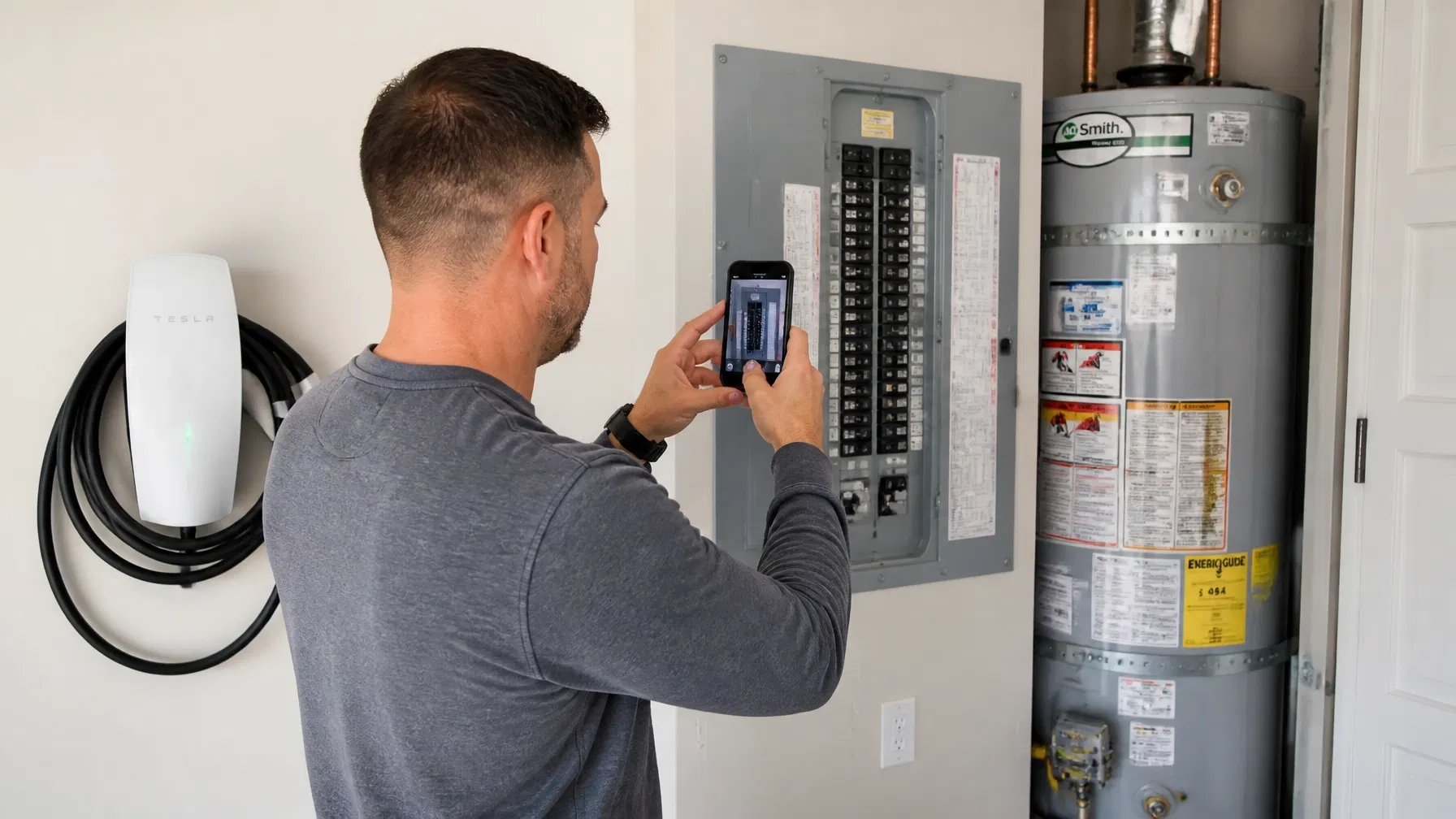
- Your electrical panel's available capacity
- Whether you expect to add another EV
- Whether you use a short off-peak electricity window
- Your future home-electrification plans
The objective is not simply to install the largest breaker possible. The objective is to provide dependable overnight charging without overloading the home or paying for electrical capacity you do not need.
How Much Does EV Charger Installation Cost in Northern Virginia?
One of the first questions homeowners ask is:
"How much will it cost to install my EV charger?"
There is no responsible universal price because the charging station itself is only one part of the project.
The final cost is often determined by the distance from the panel, the wiring route, the condition of the electrical system, and the amount of available electrical capacity.
A responsible estimate depends on site conditions, not a generic number.
Some installations are relatively straightforward. Others become more involved because of the route from the electrical panel to the charger, the condition of the existing panel, or additional work required to support the new load.
The main factors that affect cost include:
- Distance and routing from the electrical panel to the charger
- Finished versus unfinished walls and ceilings
- Indoor versus outdoor mounting
- Attached versus detached garage layout
- Trenching and hardscape crossings
- Charger output and conductor size
- Panel condition
- Available electrical capacity
- Load management or service work when required
- Permit and inspection fees
For example, a charger installed close to a suitable panel in an attached garage is usually much simpler than a charger on the opposite side of the home, a detached garage installation, or a project that requires trenching, panel corrections, or service-related work.
At Auto Charge Pros, we place significant emphasis on clean workmanship. When practical, we look for ways to conceal wiring, minimize drywall openings, keep conduit straight, and avoid making the installation look like an afterthought.
A service upgrade should not be recommended automatically simply because a homeowner wants a higher-output charger. A load calculation should be completed first, and lower charging rates or energy-management equipment should be considered when appropriate.
The only accurate way to price the work is to evaluate the actual property, the planned charger location, the available electrical capacity, and the full wiring path before providing a quote.
What Determines the Final Installation Price?
The most important cost factors include:
Distance From the Electrical Panel
Longer circuits require more copper wiring, more conduit, more labor, and often more complex routing.
The straight-line distance between the panel and charger is not always the actual wiring distance. The cable may need to travel up a wall, across a ceiling, through a basement, around mechanical equipment, and back down into the garage.
Finished Walls and Ceilings
Finished basements and drywall ceilings can make the installation more labor-intensive.
A skilled electrician may be able to fish wiring through concealed spaces, but every home is different. Fire blocking, structural beams, plumbing, ductwork, and insulation can affect the available route.
Indoor Versus Outdoor Installation
Outdoor chargers require equipment and materials that are suitable for the environment.
The installation may require:
- Weather-resistant charging equipment
- Exterior-rated conduit and fittings
- Appropriate sealing against water entry
- Protection from physical damage
- A stable mounting surface
- Consideration of snow, rain, landscaping, and vehicle movement
Attached Versus Detached Garage
A detached garage may require:
- Underground conduit
- Trenching
- A new feeder
- A garage subpanel
- Grounding-electrode work
- Concrete or asphalt cutting
- Landscape restoration
- Additional inspections
Charger Output
Higher-output chargers generally require:
- Larger copper conductors
- Larger conduit
- Larger circuit breakers
- More available electrical capacity
- More careful evaluation of the panel and service
A 16-amp or 24-amp charger may fit into a home that cannot support a 48-amp charger without additional equipment.
Electrical-Panel Condition
A panel may need work because it is:
- Full
- Damaged
- Obsolete
- Improperly installed
- Missing required labeling
- Contaminated by water or corrosion
- Equipped with incompatible breakers
- Located in an area with inadequate working clearance
An empty breaker space does not automatically mean the panel can support an EV charger.
Permit and Inspection Requirements
Most new EV charging circuits and hardwired charging stations require an electrical permit.
Permit fees, plan requirements, inspection procedures, and scheduling differ by jurisdiction.
Load-Management Equipment
An approved EV energy-management system can sometimes allow a charger to be installed without increasing the home's service size.
The equipment adds cost, but it may be significantly less expensive than a complete service upgrade.
Understanding Level 1, Level 2, and DC Fast Charging
Before choosing a charger, it is important to understand the three main charging categories.
Level 1 Charging
Level 1 charging uses a standard 120-volt receptacle.
It is the slowest charging method, but it can still be useful for:
- Plug-in hybrid vehicles
- Drivers with very short commutes
- Vehicles that remain parked for long periods
- Emergency charging
- Temporary charging while waiting for a Level 2 installation
Depending on the vehicle and available current, Level 1 charging may restore approximately 30 to 50 miles of range during a long overnight charging session.
Actual results depend on:
- Vehicle efficiency
- Battery temperature
- Outside temperature
- Charging losses
- Available receptacle current
- Other loads on the circuit
A standard receptacle circuit should be evaluated before it is used for frequent EV charging. Loose connections, worn receptacles, improper wiring, shared loads, or damaged devices can create problems during prolonged charging.
Level 2 Charging
Level 2 charging uses a 208-volt or 240-volt electrical supply and is the preferred choice for most homeowners.
Typical residential Level 2 charging power ranges from approximately 3.8 kW to 11.5 kW.
| Circuit Breaker Size | Typical Maximum Charging Output | Approximate Power at 240 Volts |
|---|---|---|
| 20 amps | 16 amps | 3.8 kW |
| 30 amps | 24 amps | 5.8 kW |
| 40 amps | 32 amps | 7.7 kW |
| 50 amps | 40 amps | 9.6 kW |
| 60 amps | 48 amps | 11.5 kW |
EV charging is treated as a continuous electrical load. The circuit must therefore be sized so that the charger does not normally exceed 80% of the breaker rating.
That is why:
- A 16-amp charger commonly uses a 20-amp circuit
- A 24-amp charger commonly uses a 30-amp circuit
- A 32-amp charger commonly uses a 40-amp circuit
- A 40-amp charger commonly uses a 50-amp circuit
- A 48-amp charger commonly uses a 60-amp circuit
The charger must also be configured so that its maximum output matches the installed circuit.
Your Vehicle Controls the Actual Charging Speed
A charging station can only offer power. The vehicle decides how much AC power it will accept.
For example, a vehicle with a 32-amp onboard charger will not charge at 48 amps simply because it is connected to a 48-amp charging station.
Before choosing a circuit size, verify the vehicle's maximum AC charging rate.
DC Fast Charging
DC fast charging is primarily used at public charging stations during road trips or high-mileage driving.
Unlike Level 1 and Level 2 charging, DC fast charging bypasses the vehicle's onboard AC charger and sends DC energy directly to the battery.
This allows compatible vehicles to charge at much higher power levels.
A vehicle may advertise public fast-charging speeds of:
- 100 kW
- 150 kW
- 250 kW
- 350 kW or more
Those public charging speeds do not apply to a typical residential Level 2 installation.
Even if a vehicle uses the same physical NACS connector for home charging and public fast charging, the electrical systems behind those charging methods are very different.
NACS, SAE J3400, and J1772 in 2026
The North American EV market is transitioning toward the connector originally developed by Tesla.
That connector is commonly called:
- NACS
- The North American Charging Standard
- SAE J3400
SAE J3400 provides an industry standard for broader adoption of the connector.
However, the transition does not mean that every vehicle currently on the road uses the same charging arrangement.
In 2026, homeowners may encounter:
- Tesla vehicles with native NACS connections
- Newer non-Tesla vehicles with native NACS ports
- Earlier vehicles with J1772 ports for home AC charging
- Vehicles with CCS1 connections for public DC fast charging
- Vehicles that require adapters
- Adapters designed only for DC charging
- Adapters designed only for AC charging
- Universal charging stations that support both NACS and J1772 vehicles
Millions of J1772-equipped vehicles remain in service, and homeowners should not assume that J1772 equipment has suddenly become unusable.
The Important Difference Between AC and DC Adapters
One of the most common sources of confusion in 2026 is adapter compatibility.
An adapter used to access a compatible Tesla Supercharger may be designed specifically for DC fast charging.
That does not automatically mean it can be used with a Tesla-style Level 2 home charging station.
Before purchasing a charger or adapter, confirm:
- The exact vehicle make and model
- The vehicle's model year
- The physical charging-port type
- The maximum AC charging rate
- Whether the adapter supports AC charging
- Whether the adapter supports DC fast charging
- Whether the vehicle manufacturer approves the adapter
- Whether the charging-station manufacturer approves the combination
Never assume that every NACS-to-CCS or NACS-to-J1772 adapter performs the same function.
Should You Choose NACS or J1772?
Choose the connector that works with the vehicle you own while considering what you may own next.
A native NACS charger may be the best choice when:
- You own a Tesla
- Your vehicle has a native NACS port
- You expect future vehicles to use NACS
- You do not regularly need to charge a J1772 vehicle
A J1772 charger may still be appropriate when:
- Your current vehicle uses J1772
- You plan to keep the vehicle for many years
- You already own compatible charging equipment
- You are comfortable using an adapter with a future NACS vehicle
A universal charging station may be the best choice when:
- Your household owns both a Tesla and a J1772 vehicle
- You expect to change vehicle brands
- Guests or tenants may need to charge different vehicles
- You want maximum flexibility from one charging station
The connector is important, but it is not the only factor. Electrical capacity, circuit size, cable length, outdoor rating, smart features, power sharing, and serviceability also matter.
How Much Charging Power Do You Actually Need?
Many homeowners begin the process by requesting the highest charging rate available.
In reality, the correct charging rate should be based on how much energy the vehicle needs before it is driven again.
Consider a homeowner who drives 40 miles per day in an EV that averages 3 miles per kilowatt-hour.
That driver uses approximately 13 to 14 kWh of energy each day.
A 24-amp Level 2 charger can deliver approximately 5.8 kW at 240 volts before normal charging losses. That charger could replace the energy used during the day in only a few hours.
For many drivers, charging at 24 or 32 amps is more than sufficient.
Higher Charging Output May Be Worthwhile When:
- The vehicle has a very large battery
- Daily mileage is high or unpredictable
- The driver frequently arrives home at a low state of charge
- The household owns more than one EV
- The utility offers a short discounted charging window
- The vehicle is used for rideshare, delivery, or business travel
- The home already has sufficient electrical capacity
- The homeowner wants additional future flexibility
Lower Charging Output May Be the Better Choice When:
- Daily mileage is modest
- The vehicle remains parked for 10 to 12 hours overnight
- The electrical service has limited remaining capacity
- The cost of a service upgrade would be substantial
- The vehicle cannot accept the charger's maximum output
- Load management is not practical
- The homeowner wants the most economical safe solution
The best charging system is not necessarily the fastest one. It is the system that reliably replaces the energy you use while fitting safely within the home's electrical capacity.
The Hyundai IONIQ 9 Example: Battery Size Versus Home Charging Speed
The Hyundai IONIQ 9 is a good example of why homeowners should separate battery capacity, home AC charging, and public DC fast charging.
The IONIQ 9 has:
- A large 110.3-kWh battery
- A native NACS connection in the United States
- An 800-volt vehicle architecture
- Approximately 11-kW AC charging capability
The 800-volt architecture provides significant advantages at compatible public DC fast-charging stations.
At home, however, charging speed is controlled by the vehicle's onboard AC charger.
Hyundai estimates approximately 9 hours and 40 minutes to charge from 10% to 100% using a 240-volt Level 2 charging source under specified conditions.
For an IONIQ 9 owner, a properly designed 48-amp charger can provide enough available power to serve the vehicle's approximately 11-kW AC charging limit.
However, an owner who normally drives 30 or 40 miles per day does not need to recharge the entire battery every night. A 32-amp or 40-amp system may still provide more than enough overnight charging.
This is why the vehicle's maximum battery capacity should not be the only factor used to size the home charging circuit.
Do You Need a 200-Amp Electrical Panel?
Not necessarily.
A home's service rating is only one part of the capacity evaluation.
A 200-amp home can already be heavily loaded by:
- Electric heating
- Multiple heat pumps
- Electric water heating
- Electric cooking equipment
- Clothes dryers
- Hot tubs
- Pools
- Saunas
- Workshops
- Accessory dwelling units
- Existing EV chargers
Meanwhile, a 100-amp or 150-amp home with gas appliances and modest electrical demand may be able to support an appropriately sized Level 2 charger.
The answer should come from a professional load calculation, not from a guess based only on the number printed on the main breaker.
What Is an Electrical Load Calculation?
A residential load calculation estimates the amount of electrical demand the home may place on the service.
The electrician evaluates equipment such as:
- Heating and air-conditioning systems
- Electric resistance heat
- Heat pumps and auxiliary heat
- Electric water heaters
- Ranges, ovens, and cooktops
- Clothes dryers
- Dishwashers
- Garbage disposals
- Hot tubs and spas
- Pool equipment
- Well pumps
- Workshop equipment
- Existing vehicle chargers
- Solar and battery systems
- The proposed EV charger
EV charging is treated as a continuous load and is generally calculated at 125% of its maximum charging current.
For example, a 48-amp charging load is associated with a 60-amp branch circuit.
A load calculation helps determine whether the proposed charger can be added without overloading the home's electrical service.
Breaker Space Is Not the Same as Electrical Capacity
A panel can have an empty breaker position and still lack enough calculated capacity for a charger.
The opposite can also be true.
A panel may have sufficient electrical capacity but no physical space for another breaker.
These are two different problems.
If the Panel Has Capacity but No Breaker Space
Possible solutions may include:
- Installing approved tandem breakers when permitted by the panel
- Reorganizing compatible circuits
- Adding a subpanel
- Replacing an undersized or obsolete panel
- Installing listed equipment designed for the existing system
A subpanel can create additional breaker spaces, but it does not increase the total electrical capacity supplied by the utility.
If the Panel Has Breaker Space but Insufficient Capacity
Possible solutions may include:
- Reducing the charger's configured output
- Installing an EV energy-management system
- Using dynamic load management
- Sharing power between multiple chargers
- Upgrading the electrical service
- Reducing or replacing other large electrical loads
The correct solution depends on the home, the charger, and the homeowner's charging needs.
Alternatives to an Immediate Electrical-Service Upgrade
A responsible electrician should evaluate practical alternatives before recommending a major service upgrade.
Reduce the Charging Output
Many charging stations can be configured to operate at a lower current.
A charger capable of 48 amps may be configured for:
- 16 amps
- 24 amps
- 32 amps
- 40 amps
- 48 amps
Lowering the charging output can reduce the calculated load while still providing dependable overnight charging.
Install an EV Energy-Management System
An approved EV energy-management system monitors the home's electrical demand.
When the home is using less power, the system allows the charger to operate.
When household demand approaches a configured limit, the system reduces or temporarily pauses EV charging.
This can allow Level 2 charging to be added to some homes without immediately replacing the electrical service.
Use Dynamic Load Management
Some charging systems can continuously adjust charging current based on the power available in the home.
Rather than simply switching the charger fully on or fully off, dynamic systems may increase or decrease charging output as other household loads change.
Use Charger Power Sharing
Two compatible chargers can sometimes share one defined electrical allocation.
When one vehicle is charging, it may receive most or all of the available power.
When two vehicles are charging, the system divides the available current between them.
Upgrade the Service When It Is Truly Necessary
A service upgrade may be the correct solution when:
- The existing electrical service is already overloaded
- The panel is damaged or obsolete
- The homeowner plans extensive electrification
- Multiple high-demand loads are being added
- Load management does not meet the homeowner's needs
- Utility or equipment requirements make other options impractical
The decision should be based on electrical calculations and site conditions—not an automatic assumption that every EV requires 200-amp service.
Hardwired Charger Versus NEMA 14-50 Outlet
Both installation methods can be appropriate when properly designed and installed.
The better choice depends on charging output, location, portability, equipment instructions, and long-term use.
| Consideration | Hardwired Charger | NEMA 14-50 Installation |
|---|---|---|
| Typical maximum charging output | Up to 48 amps on a 60-amp circuit | Up to 40 amps on a 50-amp circuit |
| Connection | Permanently connected | Charger plugs into receptacle |
| Portability | Lower | Charger can be unplugged and moved |
| Connection points | Fewer | Includes plug and receptacle contacts |
| Appearance | Usually cleaner | Requires receptacle, cover, plug, and cord clearance |
| Outdoor use | Often preferred for a permanent installation | Depends on equipment, enclosure, and local requirements |
| Best application | Daily long-term charging | Portability or a specific plug-in charging need |
Why Hardwiring Is Usually Our Preferred Option
For a permanent daily charging station, hardwiring provides several advantages.
Fewer Electrical Connection Points
A hardwired installation eliminates the plug-and-receptacle connection from the charging circuit.
Every electrical connection must be installed correctly, but reducing the number of connection points can simplify the system.
Higher Common Charging Output
Hardwired residential chargers commonly support up to 48 amps on a 60-amp circuit.
A plug-in charger using a NEMA 14-50 receptacle is generally limited to 40 amps on a 50-amp circuit.
Cleaner Appearance
A hardwired charger usually sits closer to the wall and does not require space for a large plug, receptacle cover, and additional cord.
Better for Permanent Outdoor Installations
Hardwired equipment is often the cleaner and more practical solution for an exterior installation, provided the charging station is properly rated for the location.
Reduced Chance of Unrelated Use
A dedicated hardwired circuit is clearly intended for the charger.
A receptacle may later be used for different equipment that does not match the original circuit design or installation intent.
When a NEMA 14-50 Outlet May Make Sense
A NEMA 14-50 installation may be appropriate when:
- The charging station has a factory-installed 14-50 plug
- The homeowner wants to remove or relocate the charger
- The vehicle is leased
- The charging output does not need to exceed 40 amps
- The homeowner has a specific compatible portable charger
- The location is appropriate for the receptacle and enclosure
- The installation follows the equipment instructions and locally adopted code
A NEMA 14-50 receptacle used for EV charging should not be treated like an ordinary convenience outlet.
The installation must account for:
- Receptacle quality
- Conductor size
- Breaker size
- Ground-fault protection requirements
- Enclosure type
- Terminal torque
- Plug clearance
- Cord weight
- Continuous charging demand
- Indoor or outdoor exposure
- Manufacturer instructions
A properly installed NEMA 14-50 charging circuit can be safe. The key is proper equipment selection and professional installation.
Choosing the Best Home EV Charger in 2026
There is no single best charger for every homeowner.
The best charging station is the one that matches:
- Your vehicle's connector
- Your vehicle's AC charging limit
- Your electrical capacity
- Your preferred charging output
- Your parking arrangement
- Your cable-length needs
- Your indoor or outdoor location
- Your smart-home preferences
- Your utility rate plan
- Your future vehicle plans
Popular residential options include:
| Charging Station | Connector Options | Best Suited For |
|---|---|---|
| Tesla Wall Connector | NACS/J3400 | Tesla and native-NACS households |
| Tesla Universal Wall Connector | NACS with integrated J1772 adapter | Homes with both NACS and J1772 vehicles |
| Emporia Level 2 Charger | NACS or J1772 versions | Energy monitoring, scheduling, and load-management options |
| ChargePoint Home Flex | NACS or J1772 versions | Homeowners who use the ChargePoint app and network |
| Wallbox Pulsar Plus | NACS or J1772 versions | Compact smart charging and compatible energy-management features |
| Rivian Wall Charger | Model-dependent connector | Rivian households seeking brand-matched equipment |
| Ford Home Charging Equipment | Model-dependent | Ford owners requiring vehicle-specific charging or energy features |
Specifications and product availability can change. The exact model number should be verified before the electrical circuit is designed.
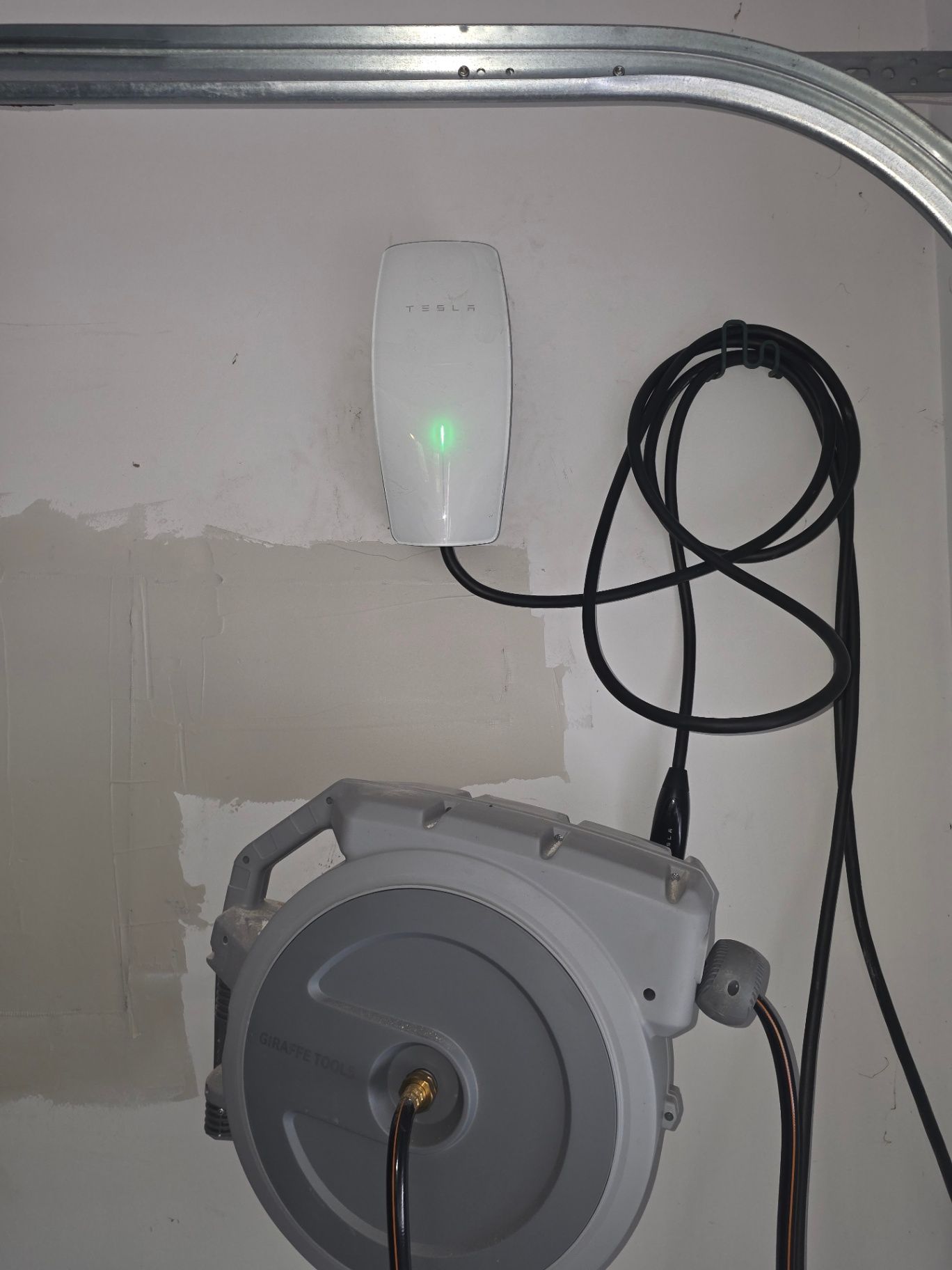
Tesla Wall Connector
The Tesla Wall Connector is one of the most commonly requested charging stations in Northern Virginia.
It is a strong choice for:
- Tesla vehicles
- Vehicles with native NACS ports
- Homeowners who prefer a compact appearance
- Multiple compatible chargers using power sharing
- Indoor or properly designed outdoor installations
Common benefits include:
- Up to 48-amp charging when properly configured
- Wi-Fi commissioning
- Software updates
- Integrated cable management
- Adjustable circuit settings
- Compatibility with Tesla vehicles
- Power sharing between compatible units
Not every Tesla accepts 48 amps. The vehicle's onboard AC charging limit should be confirmed before selecting the circuit size.
Tesla Universal Wall Connector
The Tesla Universal Wall Connector includes an integrated J1772 adapter.
It is one of the most flexible choices for:
- A Tesla and a J1772 vehicle
- A native-NACS vehicle and an older EV
- A homeowner who expects to change vehicle brands
- A garage used by multiple drivers
- A rental or guest-charging location
- A household preparing for the NACS transition
The integrated adapter reduces the need to keep a separate loose adapter in the garage.
It can be an excellent future-focused option when the household currently owns different vehicle types.
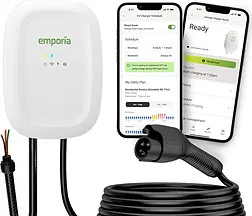
Emporia Level 2 Charger
The Emporia charger is popular with homeowners who want detailed energy monitoring and scheduling.
Depending on the model and installation method, it can support:
- NACS or J1772 charging
- Hardwired installation
- Plug-in installation
- Charging schedules
- Energy-consumption tracking
- Integration with compatible Emporia energy-monitoring products
- Compatible load-management functions
It can be useful for homeowners who want to understand how much electricity the vehicle uses or schedule charging during lower-cost hours.
ChargePoint Home Flex
The ChargePoint Home Flex is a common choice for drivers who already use the ChargePoint public-charging network.
Depending on the specific model, it may offer:
- NACS or J1772 connectors
- Adjustable charging output
- Wi-Fi connectivity
- App-based scheduling
- Energy tracking
- Integration with the ChargePoint account
The exact model, circuit requirements, and maximum output should be verified before installation.
Wallbox Pulsar Plus
The Wallbox Pulsar Plus is a compact smart charger available in different connector configurations.
It may appeal to homeowners who want:
- A small wall-mounted unit
- Wi-Fi and Bluetooth connectivity
- Charging schedules
- Energy monitoring
- Compatible dynamic load-management features
- NACS or J1772 options
As with any charger, the exact product specifications should be confirmed before the circuit is installed.
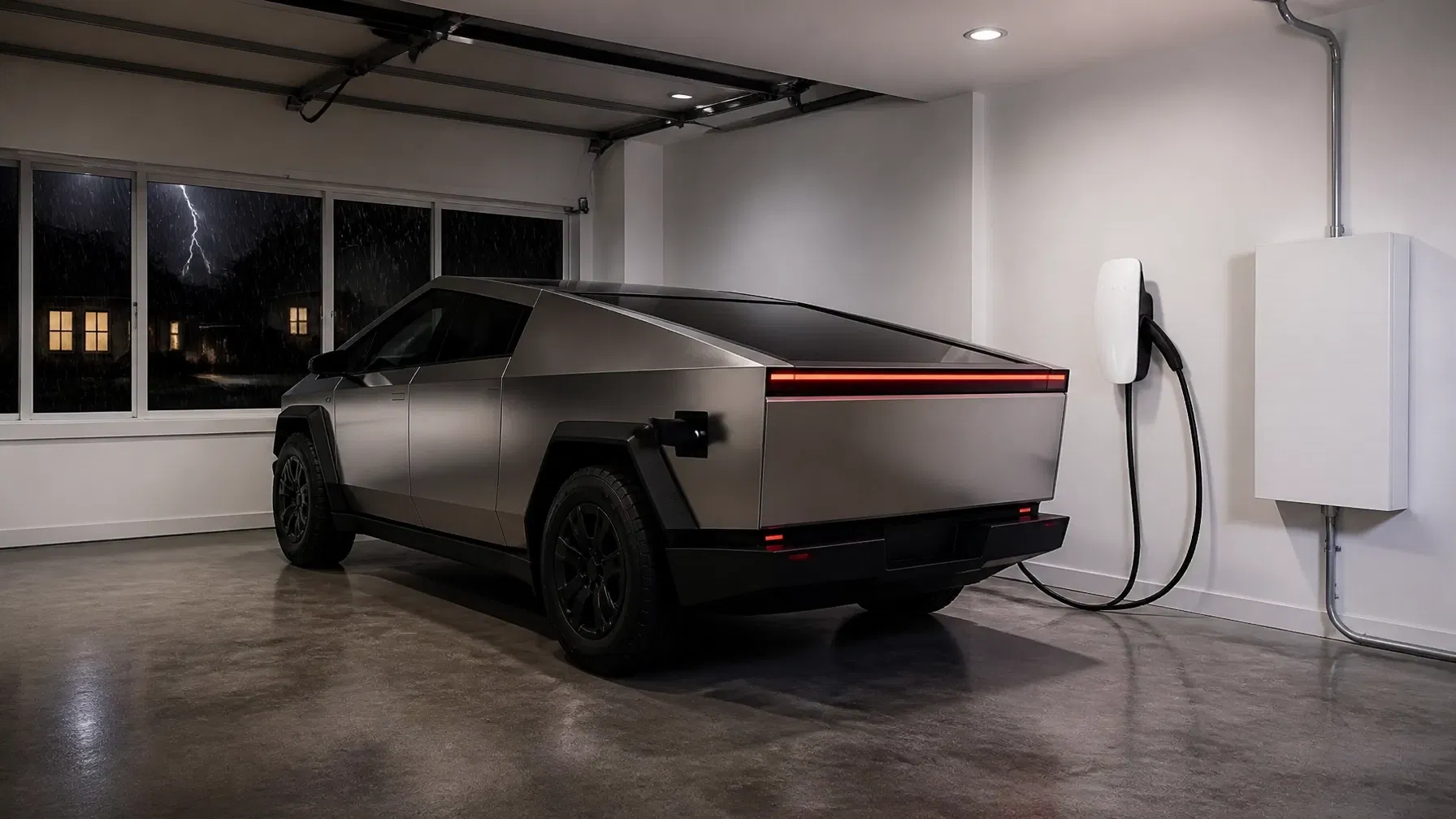
Tesla Installation Considerations
Most Tesla owners are well served by a Tesla Wall Connector installed on a circuit that matches the vehicle and the home's capacity.
A 48-amp charger is common, but some Tesla variants accept a lower maximum AC charging current.
Before installation, confirm:
- Exact Tesla model
- Model year
- Vehicle AC charging limit
- Charger location
- Desired charging output
- Need for power sharing
- Possibility of adding a non-Tesla EV
For a household that may own both Tesla and non-Tesla vehicles, the Tesla Universal Wall Connector is often the more flexible choice.
Rivian Installation Considerations
Rivian connector arrangements depend on vehicle model and model year.
Newer Rivian vehicles may use native NACS connections, while earlier vehicles may use J1772 for home AC charging and CCS1 for public DC fast charging.
Before installing a Rivian charger, confirm:
- Exact Rivian model
- Model year
- Native connector type
- Maximum AC charging rate
- Whether an adapter supports AC charging
- Whether future vehicles will share the charger
- Whether the homeowner wants brand-specific or universal equipment
Do not assume that a public fast-charging adapter is automatically suitable for home Level 2 charging.
Ford Installation Considerations
Ford charging compatibility also varies by vehicle and model year.
Some Ford owners may use:
- J1772 home charging
- NACS home charging
- A separate NACS adapter for compatible public fast charging
- Ford-branded charging equipment
- Third-party universal charging stations
- Vehicle-to-home equipment on compatible vehicles
Before installation, verify the exact vehicle specifications and adapter functions.
A NACS adapter intended for public DC fast charging should not automatically be assumed to work with an AC Level 2 home charger.
Hyundai and Kia Installation Considerations
Hyundai and Kia connector types vary by model year.
Some vehicles use J1772 for home charging, while newer vehicles may use native NACS connections.
Before selecting the charger, verify:
- Exact model and model year
- Connector type
- Maximum AC charging rate
- Manufacturer-approved adapters
- Whether another household vehicle will share the charger
The Hyundai IONIQ 9 is a major native-NACS example, but the brand name alone should not be used to select the charging connector.
BMW, Mercedes-Benz, Audi, Volkswagen, Volvo, Polestar, and Other Brands
The same evaluation applies to every EV manufacturer.
Document the following before installation:
- Exact vehicle make
- Exact model
- Model year
- Native charging port
- Maximum onboard AC charging rate
- Approved AC adapters
- Approved DC adapters
- Future household vehicles
A universal charging station may be particularly valuable when a household owns multiple brands or expects to replace a J1772 vehicle with a native-NACS model.
Charger Placement Matters More Than Many Homeowners Expect
The charger should not simply be mounted in the easiest location for the electrician.
It should be located where it will remain convenient and safe for daily use.
Consider:
- Where the vehicle's charging port is located
- Whether the vehicle is parked forward or backed in
- Whether a second vehicle will need access
- Whether the charging cord crosses a walkway
- Whether the garage door can close without contacting the cable
- Whether the cable reaches without being stretched
- Whether the unit is protected from vehicle impact
- Whether snow, water, or landscaping will affect an outdoor charger
- Whether the charger remains accessible if storage is added later
A few additional feet of wiring during the original installation may be less expensive than relocating the charger after purchasing a different vehicle.
EV Charger Permits and Inspections in Northern Virginia
Most new hardwired EV charging stations and new 240-volt EV charging circuits require an electrical permit.
Using a listed portable charger with an existing compliant receptacle may be treated differently from:
- Installing a new receptacle
- Extending an existing circuit
- Installing a new 240-volt circuit
- Hardwiring a charging station
- Adding a subpanel
- Replacing an electrical panel
- Upgrading the electrical service
- Installing underground wiring
Requirements vary by jurisdiction.
Depending on the property, the authority having jurisdiction may be a county, independent city, or town.
Auto Charge Pros serves homeowners throughout:
- Loudoun County
- Fairfax County
- Prince William County
- Fauquier County
Permit procedures, inspection requirements, adopted code editions, and documentation requirements can differ between jurisdictions.
A professional contractor should verify the requirements for the specific property rather than assuming that the rules are identical throughout Northern Virginia.
Why the Electrical Permit Matters
A permit creates an official record of the electrical work and provides an independent inspection of important safety details.
An inspection may evaluate:
- Breaker size
- Conductor size
- Grounding and bonding
- Charger configuration
- Equipment listing and labeling
- Panel compatibility
- Working clearances
- Protection from physical damage
- Outdoor equipment ratings
- Conduit and wiring methods
- Required disconnecting means
- Load calculations
- Manufacturer installation instructions
The permit and inspection process also helps ensure that the project is evaluated under the locally adopted electrical code.
EV charging equipment is covered primarily under Article 625 of the National Electrical Code, along with other applicable sections.
Because Virginia jurisdictions may adopt different code editions at different times, the exact requirements should be confirmed for the project location.
The Auto Charge Pros Installation Process
A professional installation begins before the first hole is drilled.
Step 1: Vehicle and Charging Review
We gather information about:
- Vehicle make
- Vehicle model
- Model year
- Native charging connector
- Maximum AC charging rate
- Preferred charging station
- Daily mileage
- Typical overnight parking time
- Possibility of adding a second EV
This prevents the circuit from being oversized, undersized, or designed for the wrong connector.
Step 2: Electrical-System Evaluation
We evaluate:
- Electrical-service rating
- Main panel condition
- Available breaker spaces
- Existing large electrical loads
- Panel manufacturer and compatibility
- Proposed charger output
- Potential need for load management
- Potential need for a panel or service upgrade
An empty breaker space is not considered proof of available electrical capacity.
Step 3: Wiring-Route Planning
We determine the most practical route between the electrical panel and charger.
The route may involve:
- Garage walls
- Finished basement ceilings
- Attics
- Crawlspaces
- Utility rooms
- Exterior walls
- Surface-mounted conduit
- Underground conduit
- Detached structures
Our goal is to balance electrical safety, accessibility, cost, and appearance.
Step 4: Charger and Circuit Selection
We match the equipment to:
- Vehicle compatibility
- Desired charging speed
- Available electrical capacity
- Indoor or outdoor location
- Cable length
- Smart features
- Power-sharing requirements
- Future vehicle plans
Step 5: Permit Coordination
When a permit is required, the project is submitted to the applicable jurisdiction.
Permit requirements may include:
- Contractor information
- Equipment specifications
- Panel information
- Circuit size
- Load calculations
- Site information
- Electrical diagrams
- Additional service-upgrade documentation
Step 6: Installation
The installation may include:
- Mounting the charging station
- Installing the circuit breaker
- Installing copper conductors
- Installing conduit or concealed wiring
- Making panel connections
- Making charger terminations
- Labeling the circuit
- Configuring the charger output
- Sealing exterior penetrations
- Installing required protection
Step 7: Commissioning
After energizing the system, we verify:
- Proper charger startup
- Correct circuit configuration
- Vehicle communication
- Charging operation
- Wi-Fi or app setup when requested
- Cable storage
- Customer operation
Step 8: Inspection and Closeout
When required, the electrical inspection is completed through the local jurisdiction.
The project should remain open until the installation receives final approval.
How Long Does EV Charger Installation Take?
Many straightforward residential installations can be physically completed in one working day.
A typical project may take approximately three to six hours when:
- The panel is near the garage
- Electrical capacity is available
- The route is accessible
- No major panel work is required
- No trenching is involved
More complex projects may take longer when they include:
- Long concealed wiring routes
- Finished-space access
- Outdoor conduit
- Trenching
- Detached garages
- Concrete or asphalt work
- Panel replacement
- Service upgrades
- Utility coordination
- Extensive electrical corrections
The electrical inspection is often scheduled separately from the installation date.
Outdoor EV Charger Installation
A home EV charger can be installed outdoors when the equipment is listed and suitable for the environment.
An outdoor installation should account for:
- Rain and moisture
- Snow and ice
- Direct sunlight
- Temperature exposure
- Drainage
- Landscaping
- Vehicle movement
- Cable storage
- Physical impact
- Water entry at conduit and wall penetrations
The charger should be mounted on a stable surface in a location that is convenient without placing the equipment in the direct path of a vehicle.
Possible mounting locations include:
- Exterior house wall
- Garage exterior wall
- Post or pedestal
- Carport column
- Purpose-built charging structure
The charging cable should not routinely rest in water, cross a public walkway, or create a trip hazard.
Detached-Garage EV Charger Installation
Detached garages are often more complex than attached-garage installations.
The project may require:
- Evaluation of the existing garage feeder
- A new underground conduit
- A larger feeder
- A garage subpanel
- Grounding-electrode work
- Trenching
- Concrete or asphalt cutting
- Landscape restoration
- Additional permit inspections
An existing garage circuit should not be assumed to have enough capacity for a Level 2 charger.
Many detached garages were originally supplied only for:
- Lighting
- A garage-door opener
- A few 120-volt receptacles
- Small tools
A proper evaluation is necessary before adding a large continuous charging load.
Planning for Two EVs
A two-EV household does not automatically need two separate 60-amp circuits.
Depending on the chargers and the available electrical capacity, the system may use:
- Two chargers with power sharing
- One charger positioned to reach either vehicle
- One higher-output charger and one lower-output charger
- Dynamic load management
- Scheduled charging
- A future-ready conduit pathway
- A feeder sized for planned expansion
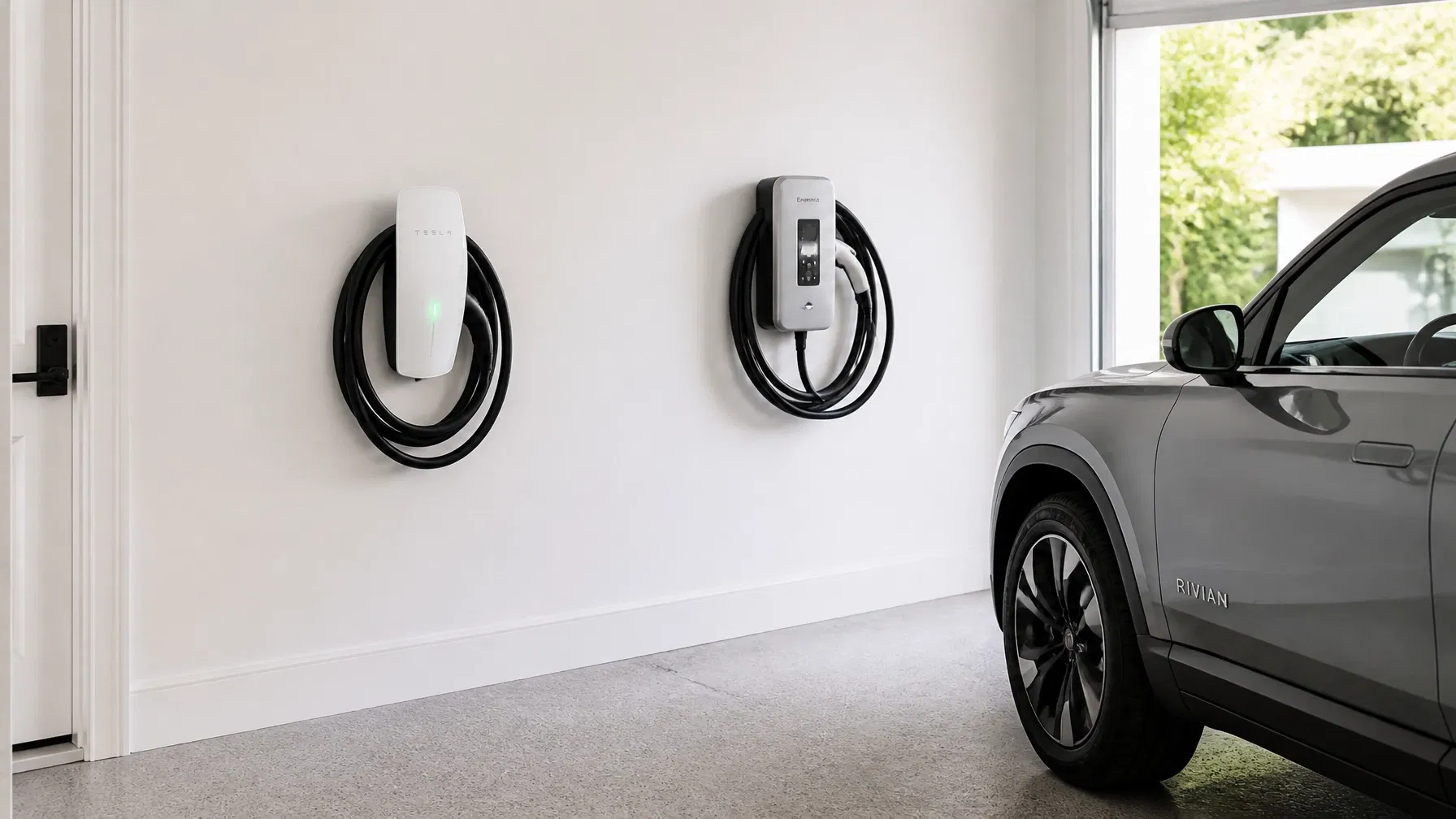
Charger Power Sharing
Compatible chargers can divide a defined amount of available power.
For example, two chargers may share a fixed electrical allocation.
When only one vehicle is connected, it can receive more power.
When both vehicles charge at the same time, the system reduces each charger's output so that the combined load remains within the configured limit.
This can provide practical overnight charging without doubling the demand on the home.
One Charger for Two Parking Spaces
In some garages, one charger with a properly positioned cable can reach either vehicle.
This may be sufficient when:
- The vehicles are not charged every night
- Daily mileage is moderate
- Parking positions are consistent
- The charger has a long enough cable
- The cable does not create a trip hazard
Prepare for the Second Charger Now
Even when only one charger is being installed, it may be wise to consider:
- Charger placement for both parking spaces
- Conduit for a future circuit
- Subpanel capacity
- Power-sharing capability
- Network connectivity
- Electrical-service capacity
- Future connector types
Planning during the first installation can reduce the cost of adding a second charger later.
Charging During Off-Peak Electricity Hours
Smart scheduling may reduce charging costs when the utility offers time-based rates.
Northern Virginia homeowners are commonly served by utilities such as:
- Dominion Energy Virginia
- NOVEC
Utility rates, enrollment requirements, metering requirements, and time-of-use periods can change.
Homeowners should review the current utility program before making a financial decision.
A smart charger or vehicle charging schedule may allow the homeowner to:
- Plug in immediately after arriving home
- Delay charging until a lower-cost period begins
- Stop charging before higher rates resume
- Track charging energy
- Coordinate charging with household demand
It is important to determine whether the utility's time-of-use rate applies only to EV charging or to the entire home.
A rate with inexpensive overnight electricity may be beneficial for a household that can shift major usage away from more expensive peak periods.
Is There a Federal Tax Credit for EV Charger Installation in 2026?
The federal Alternative Fuel Vehicle Refueling Property Credit changed during 2026.
For qualifying residential charging property placed in service between January 1, 2023, and June 30, 2026, eligible homeowners could potentially claim:
- 30% of eligible installation and equipment costs
- Up to $1,000 per charging item
Residential eligibility generally depended on requirements such as:
- Installation at the taxpayer's principal residence
- Installation in an eligible census tract
- The date the equipment was placed in service
- Compliance with current IRS rules
Under current federal law as of July 20, 2026, a new residential charger placed in service after June 30, 2026, does not qualify for this federal credit.
A homeowner who completed a qualifying installation on or before June 30, 2026, may still be able to claim the credit on the applicable tax return if all requirements were satisfied.
Tax laws can change, and individual eligibility varies.
Homeowners should review current IRS guidance and consult a qualified tax professional before relying on a tax credit.
Future-Proofing Your EV Charger Installation
No charging installation can guarantee compatibility with every future vehicle, but good planning can reduce the cost of future changes.
Choose the Charger Location Carefully
Consider vehicles with charging ports located at:
- Driver-side rear
- Passenger-side rear
- Driver-side front
- Passenger-side front
- Front center
The charger should reach the vehicle whether it is backed into the garage or pulled forward whenever practical.
Consider Cable Length
A longer cable provides flexibility, but the cable still needs to be stored safely.
The cord should not:
- Create a trip hazard
- Be stretched tightly
- Rest under a garage door
- Be driven over
- Rest in standing water
- Rub against sharp surfaces
Consider a Universal Connector
A universal charger can be valuable when:
- The current vehicle uses J1772
- The next vehicle may use NACS
- The household owns two different EV brands
- Guests or tenants may use the charger
Install a Practical Wiring Path
Where practical, an accessible conduit or raceway can make future wiring changes easier.
A future-ready pathway may be more valuable than installing unnecessarily large conductors that the current electrical system cannot use.
Plan for Future Home Electrification
The EV charger is only one part of the home's electrical future.
Homeowners may later add:
- A second EV
- Heat-pump HVAC
- Heat-pump water heating
- Induction cooking
- Solar panels
- Battery storage
- A hot tub
- A pool
- An accessory dwelling unit
- Workshop equipment
The charger should be considered as part of the home's broader electrical plan.
What About Bidirectional Charging?
Bidirectional charging can allow a compatible vehicle to send power back to:
- The home
- The electrical grid
- Certain electrical loads
These systems may be described as:
- Vehicle-to-home
- V2H
- Vehicle-to-grid
- V2G
- Vehicle-to-load
- V2L
A standard Level 2 charger does not automatically support bidirectional charging.
A complete bidirectional system may require:
- A compatible vehicle
- Compatible charging equipment
- Transfer or isolation equipment
- Specialized electrical controls
- Utility approval
- Manufacturer-specific hardware
- Additional permitting
- A properly designed connection to the home
A NACS connector alone does not make a charging station bidirectional.
Homeowners interested in backup-power capability should identify the exact vehicle and system before electrical work begins.
Why Northern Virginia Homeowners Choose Auto Charge Pros
Auto Charge Pros is a locally owned electrical company specializing in EV charger installations and residential electrical services.
We serve homeowners throughout:
- Loudoun County
- Fairfax County
- Prince William County
- Fauquier County
Our approach emphasizes:
- Virginia Master Electrician oversight
- Owner-operated service
- Careful load calculations
- Code-compliant circuit design
- Permit coordination
- Clean workmanship
- Straight and organized conduit
- Minimal disruption to finished spaces
- Appropriate charger sizing
- Honest service-upgrade recommendations
- Hardwired and plug-in options
- NACS and J1772 compatibility
- Outdoor and detached-garage solutions
- Load-management options
- Future-ready planning
We do not begin with the assumption that every homeowner needs the largest charger or a new 200-amp electrical service.
We evaluate the vehicle, the home, and the homeowner's daily charging needs before recommending a solution.
Frequently Asked Questions
How Much Does EV Charger Installation Cost in Northern Virginia?
There is no responsible universal price for EV charger installation because each home is different.
The final cost depends on factors such as:
- The distance and routing from the panel to the charger
- Finished versus unfinished walls and ceilings
- Indoor versus outdoor installation
- Attached versus detached garage layout
- Trenching and hardscape crossings
- Charger output and conductor size
- Panel condition
- Available electrical capacity
- Any load management or service work required
- Permit and inspection fees
A relatively direct installation may be simpler than a project involving a long concealed wiring route, exterior conduit, detached structures, trenching, or panel-related work.
A final quote should be based on the actual property after a site visit.
Do I Need a 200-Amp Panel to Charge an EV at Home?
No.
Some 100-amp and 150-amp homes can support Level 2 charging, particularly when they have gas appliances, modest electrical demand, reduced charging output, or an approved energy-management system.
Some 200-amp homes are already heavily loaded.
A professional load calculation is required to determine the correct solution.
What Circuit Is Required for a 48-Amp Charger?
A typical 48-amp Level 2 charger requires a dedicated 60-amp circuit.
The installation must also follow:
- Charger manufacturer instructions
- Conductor requirements
- Breaker requirements
- Panel requirements
- Locally adopted electrical code
The charger should be configured so that its maximum output does not exceed the circuit rating.
Is 48-Amp Charging Worth It?
It may be worthwhile for:
- Large-battery vehicles
- High daily mileage
- Short off-peak charging windows
- Multiple-EV households
- Drivers who frequently arrive home with a low battery
Many homeowners are completely satisfied with 24-amp or 32-amp charging.
The correct answer depends on the energy that must be restored before the vehicle is driven again.
How Fast Is a 40-Amp Home Charger?
At 240 volts, a 40-amp charger provides approximately 9.6 kW before normal charging losses.
Actual range added per hour depends on:
- Vehicle efficiency
- Battery temperature
- Outside temperature
- Charging losses
- Vehicle AC charging limit
A more efficient vehicle will add more miles of range per hour than a large electric truck or SUV using the same charger.
Is Hardwired Charging Better Than a NEMA 14-50 Outlet?
For a permanent daily charging station, hardwiring is generally our preferred option.
Hardwiring:
- Eliminates the plug-and-receptacle connection
- Commonly supports up to 48-amp charging
- Usually creates a cleaner installation
- Is often better suited to permanent outdoor charging
A properly installed NEMA 14-50 circuit can still be appropriate when portability is important or the charger is specifically designed for plug-in use.
Will a Tesla Charger Work With a Ford, Rivian, Hyundai, or Kia?
It depends on:
- Vehicle model
- Model year
- Native charging port
- Charging-station connector
- Adapter type
- Whether the adapter supports AC charging
A Tesla Universal Wall Connector can charge native-NACS vehicles and J1772 vehicles through its integrated adapter.
A standard Tesla Wall Connector may require an approved AC adapter for a J1772 vehicle.
An adapter intended for public DC fast charging may not work for home AC charging.
Does the Hyundai IONIQ 9 Use NACS?
The U.S.-market Hyundai IONIQ 9 uses a native NACS connection.
It has a 110.3-kWh battery and approximately 11-kW AC charging capability.
The vehicle's 800-volt architecture primarily benefits compatible public DC fast charging. Home charging speed remains limited by the onboard AC charger.
Does Rivian Use NACS or J1772?
The answer depends on the Rivian model year.
Newer Rivian vehicles may use native NACS connections, while earlier vehicles may use J1772 for home AC charging and CCS1 for public DC fast charging.
The exact model year and connector should be confirmed before purchasing a home charging station.
Do I Need an Electrical Permit?
A new hardwired charger or new 240-volt charging circuit generally requires an electrical permit.
Using an existing compliant receptacle with listed portable charging equipment may be treated differently.
Requirements vary by county, city, and town.
The contractor should confirm the requirements for the specific property.
How Long Does Installation Take?
Many straightforward installations can be completed in approximately three to six hours.
Complex installations may require additional time because of:
- Long wiring routes
- Finished walls
- Outdoor conduit
- Trenching
- Detached garages
- Panel replacement
- Service upgrades
- Utility coordination
The jurisdictional inspection is often completed on a separate date.
Can an EV Charger Be Installed Outdoors?
Yes.
The charger and wiring method must be suitable for the environment.
The installation should address:
- Rain
- Snow
- Moisture
- Sunlight
- Temperature
- Drainage
- Vehicle impact
- Cable storage
- Exterior penetrations
- Equipment mounting
Can I Install Two Chargers Without Upgrading My Electrical Service?
Possibly.
Compatible charging stations can share a defined amount of power, or an energy-management system can control charging based on the home's available capacity.
A professional load calculation is still required.
Can a Subpanel Increase My Home's Electrical Capacity?
No.
A subpanel can create additional breaker spaces and improve circuit organization, but it does not increase the electrical capacity supplied by the utility.
If the service lacks capacity, the solution may require lower charging output, energy management, or a service upgrade.
Is the Federal EV Charger Tax Credit Available After June 30, 2026?
Under current federal law as of July 20, 2026, new residential charging property placed in service after June 30, 2026, does not qualify for the federal Alternative Fuel Vehicle Refueling Property Credit.
Qualifying installations completed on or before June 30, 2026, may still be eligible if all applicable requirements were met.
Consult current IRS guidance and a qualified tax professional.
Schedule Your Northern Virginia EV Charger Installation
Your EV charger should be designed around more than the vehicle parked in your driveway today.
The installation must work with:
- Your home's electrical capacity
- Your vehicle's charging capability
- Local permit requirements
- Your daily driving habits
- Your future vehicle plans
- Your home's long-term electrical needs
Auto Charge Pros provides professional residential EV charger installation throughout Loudoun County, Fairfax County, Prince William County, and Fauquier County.
We install charging solutions for:
- Tesla
- Rivian
- Ford
- Hyundai
- Kia
- BMW
- Mercedes-Benz
- Audi
- Volkswagen
- Volvo
- Polestar
- Chevrolet
- Cadillac
- GMC
- Nissan
- Lucid
- Other electric vehicles
Whether you need a Tesla Wall Connector, a universal NACS/J1772 charger, a hardwired Level 2 charger, a NEMA 14-50 circuit, an outdoor charging station, load-management equipment, or an evaluation of your electrical panel, we will help you choose the correct solution.
Visit: www.autochargepros.com
Safe electrical work. Clean installation. Honest recommendations. A home charging system designed correctly from the start.