
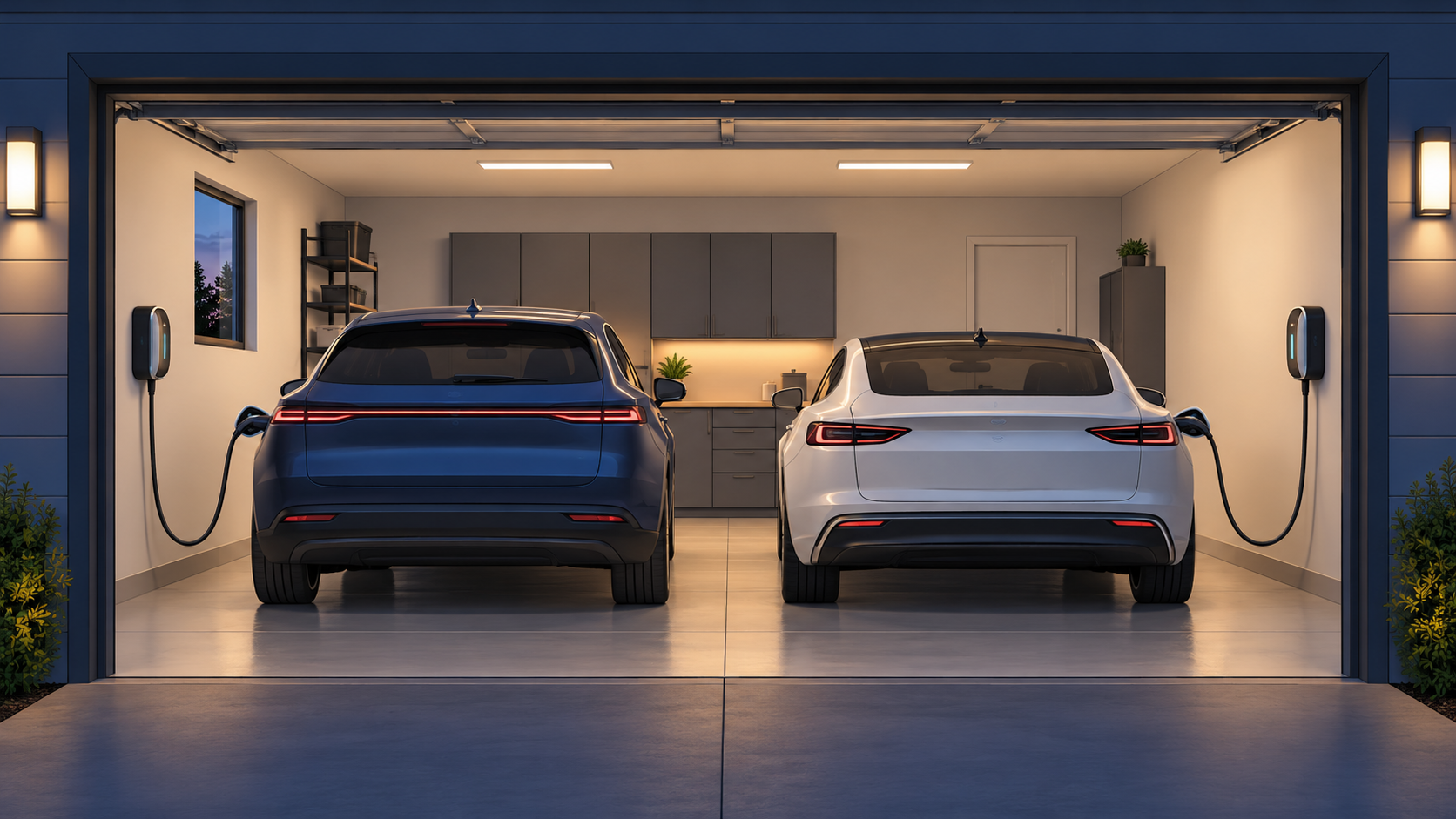
A second electric vehicle changes the household routine. Who gets the charger tonight? Will both cars be ready in the morning? Does adding another charging station mean upgrading the electrical service?
For Northern Virginia homeowners, the useful starting point is a plan for both vehicles: where they park, when they are home, and how much driving each needs to recover. Buying two chargers first can leave the most important questions unanswered.
Start with the driving routine
Write down each vehicle’s usual daily mileage, arrival time and next departure. Include the difficult days: a late arrival after a long commute, an early airport run, or a weekend when both cars need charging.
The Department of Energy explains that home charging needs depend on driving patterns and time parked. Level 1 can meet some drivers’ needs; Level 2 can suit longer commutes or shorter charging windows. An electrician should assess the home’s available electrical capacity. Read DOE’s home charging guidance.
Ask yourself a practical question: would sharing a plug require someone to move a car or go back outside late at night? A setup that looks economical on paper should also work on a busy Tuesday.
Compare three possible setups
Share one charging station
One station may be worth considering when the vehicles’ charging needs and schedules leave room to take turns. Think through where the cable reaches and who will move it. Make a plan for nights when both vehicles arrive with more energy to replace than usual.
Install two independently supplied stations
Two stations let each driver plug in at their usual parking spot. Ask your installer to compare the electrical work, cable routes and available charging output for each vehicle. Include any anticipated repair of walls or ceilings in the written scope.
Use compatible chargers with power sharing
Some charging systems coordinate multiple stations within an installer-configured limit. Tesla’s Group Power Management, for example, supports up to six Gen 3 Wall Connectors and distributes power among them. Its documentation says compatible Gen 3 variants can be combined, but chargers from other manufacturers cannot join that Tesla group. See Tesla’s power management guidance.
Two plugged-in vehicles therefore do not automatically mean two vehicles charging at each station’s maximum output.
Power sharing and whole-home monitoring are different
Sharing a charging allowance among stations is different from adjusting charging in response to the home’s other electrical loads.
Tesla calls its home-load-responsive feature Dynamic Power Management and requires a compatible meter. Its current support page says that feature is limited to a single Wall Connector and cannot operate across multiple Wall Connectors. Do not assume those two features can be combined. Have the installer verify the proposed equipment and current manufacturer instructions. Tesla feature details and limitations.
Plan the parking spaces before the hardware
Stand where each car normally parks and consider:
- Where is the charge port on each vehicle?
- Will either driver need to reverse into the space?
- Can the cables be stored conveniently after use?
- Will shelving, a garage door or a walking route interfere?
- Is a future vehicle likely to park in a different position?
- If one vehicle parks outside, what equipment and placement suit that location?
Bring photos of the parking arrangement to the estimate conversation. The most useful photos show the whole area, not just the spot where you imagine a charger going.
Does a second EV require a panel upgrade?
Not automatically—but a remote guess cannot establish whether your home can support the proposed installation. DOE advises having an electrician assess capacity and follow applicable installation requirements. EV charging is a continuous electrical load, and the installation must comply with local and state rules. DOE installation guidance.
Ask for an explanation of the proposed charging capacity, any management equipment, and why an upgrade is or is not part of the recommendation. For related background, see our panel upgrade guide.
What to include in your estimate request
Send the make, model and year of both vehicles, details of any existing charger, approximate daily mileage, and photos of the parking spaces and closed electrical panel. Leave electrical covers in place.
Ask the written proposal to identify:
- The charging equipment and compatibility with both vehicles.
- The intended output when one or both vehicles are charging.
- Any power sharing or monitoring equipment.
- The wiring route and included wall repairs.
- Permit and inspection responsibilities.
- Setup, testing and the homeowner handoff.
If you are still gathering information about household appliances, our load calculation preparation checklist can help you prepare for the conversation.
Plan for both cars together
Whether your household is in Ashburn, Leesburg, Fairfax or elsewhere in Northern Virginia, bring both vehicles into the planning conversation—even if you are only installing the first station today.
Request an estimate from Auto Charge Pros and tell us how both cars fit into your day. That gives the estimate a clear goal: a charging arrangement that suits your home and your routine.
*Manufacturer feature availability can change. Confirm compatibility and installation requirements for the equipment being proposed.*